Introduction to DevOps – How It Works and Why It’s Important

👋 Hello! I’m Ansari Anas, Passionate about DevOps. Currently upskilling in DevOps tools and practices to bridge the gap between engineering and technology. Passionate about learning, problem-solving, and contributing to efficient software delivery.
SKILLS:
🔹 Languages & Runtimes: Python, Shell Scripting
🔹 Cloud Technologies: AWS
🔹 Other Tools: Linux, Git, Jira,
🔹 Web Development: HTML, CSS, JavaScript React.js, Tailwind CSS
🤝Let's Connect & Grow:
If you find my profile suitable for the role you are searching for, please feel free to reach out to me at ansariii.5130@gmail.com
What is DevOps?
So in today’s fast pace world tech companies and startup want to deliver their application/software in quick manner this is where DevOps comes into picture.
DevOps is a culture or process of improving the application delivery by ensuring that there is a proper automation, quality, monitoring/observability and continuous testing.
Example: let say delivering software manually takes 10 days with manual approach this is where DevOps comes in the picture it automates the process with the help of various CI/CD Tools Jenkins etc.
Why DevOps?
Back in the days application deployment process was manual there were several roles like Developer, Server Admin , System admin . There was different teams for each tasks due to several teams worked separately which often caused delays, bugs, and communication gaps. DevOps bridges this gap by encouraging collaboration, automation, and continuous improvement
System Admin - create physical server hardware
Server Admin - perform a task like setting up Linux, Networking, Monitoring, Access control
Build & Release - Make a executable build on server and deploy on server
Tester - Test the application if everything works as expected or not
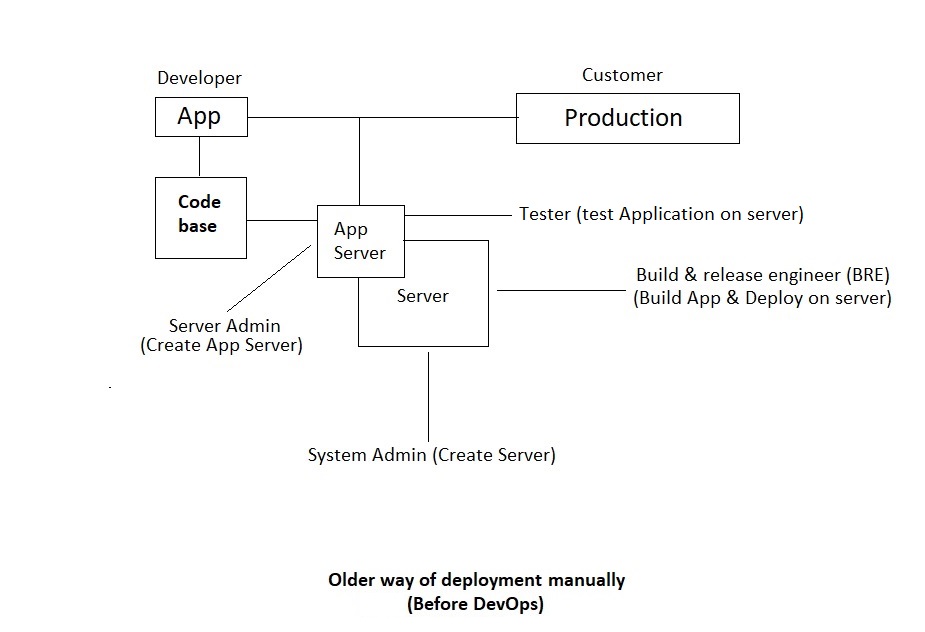
In todays world all of these tasks are handled by single team through DevOps Engineer
Some key benefits of DevOps include:
🚀 Faster delivery of software updates
✅ Improved reliability and fewer bugs
🤝 Better collaboration between teams
🔄 Continuous feedback loop for quick improvements
How DevOps work?
DevOps relies on several tools to make process faster
Continuous Integration (CI) - A team of software developers merge their code on GitHub repository to catch bug quickly.
Continuous Delivery(CD) - Changes in the code are automatically detected and prepared for release.
Automation - Few tasks are repetitive so they are automated like testing, deployment and monitoring.
Monitoring - Systems are continuously monitored to detect problems quickly and improve performance.
What are the different DevOps Tools?
Remember DevOps isn’t about tools only but tools makes it a powerful process.
Git & GitHub/GitLab – Version control and collaboration
Jenkins – Automation server for CI/CD
Docker – Containerization of applications
Kubernetes – Orchestration of containers or handling of containers
AWS, Azure, GCP – Cloud platforms that support DevOps practices
Short Form & Abbreviations
CI - Continuous Integration
CD - Continuous Delivery(CD)
🧩 Conclusion
In today’s digital era, speed, quality, and reliability are everything — and that’s exactly what DevOps delivers. It bridges the gap between development and operations, ensuring that software is deployed faster, tested continuously, and monitored efficiently.
By adopting DevOps practices, organizations not only improve collaboration but also achieve faster innovation and higher customer satisfaction. Whether you’re a beginner or an experienced engineer, learning DevOps is a great step toward building a strong career in modern IT and cloud environments.


